Nobody warns you about this when you’re starting a business.
You work hard. You get customers. You grow. And then, almost overnight, the same success that felt like victory starts to feel like a vice. More customers mean more messages. More messages mean more missed follow-ups. More missed follow-ups means complaints. And the complaint management system you’re running? It’s a WhatsApp group, two personal phone numbers, and one very tired operations person holding everything together through sheer memory.
This is the Nigerian SME growth paradox. And it catches almost every founder off guard.
The right service desk software for SMEs doesn’t add to the complexity. It dismantles it. But choosing poorly, buying a tool built for enterprise teams, or picking the cheapest option without thinking about what you actually need can make things worse before they get better.
This guide is a practical, no-fluff checklist for Nigerian SME owners, operations managers, and founders who need to make the right call without wasting time, money, or team momentum.
Why Service Desk Software for SMEs Is Important
Here’s a question worth sitting with: what happens to your customer relationships when your best support person leaves?
In most Nigerian SMEs, the honest answer is: everything falls apart. The “system” isn’t a system at all it’s a person. And people leave, get sick, go on leave, and take their customer knowledge with them.
A service desk replaces person-dependent processes with platform-dependent ones. Customer history lives in the system, not in someone’s phone. Ticket ownership is assigned, not assumed. Follow-ups are automated, not hoped for.
Beyond resilience, there’s a growth argument. Research from Salesforce’s 2024 State of Service report shows that 88% of customers are more likely to repurchase from a company that delivers great service. The same report found that 85% of service leaders now expect their teams to actively generate revenue not just resolve issues. That expectation only becomes achievable with structured, data-driven systems behind it.
For Nigerian SMEs facing pressure to grow revenue with limited headcount, customer retention isn’t a nice-to-have. It’s survival.
See how NotchCRM’s Service Desk is built for Nigerian SMEs simple to adopt, powerful enough to scale.
Key Features SMEs Should Prioritise
Not every feature in a service desk brochure belongs in your decision. Here’s what actually matters for an SME:
Simple, Intuitive Interface
Your team isn’t composed of CX software specialists. If agents need a manual to log a ticket, the tool will fail within a month not because it’s bad, but because adoption requires ease. Prioritise platforms where the core workflows are learnable in hours, not days.
Automation That Runs Without Babysitting
The value of automation in an SME context is massive because it replaces the manual follow-up work that currently eats hours of your team’s week. Look specifically for: auto-acknowledgement messages, ticket routing to the right team member, escalation triggers for overdue tickets, and scheduled follow-up reminders. These four automations alone can reclaim significant time each week.
WhatsApp-Native Omnichannel Support
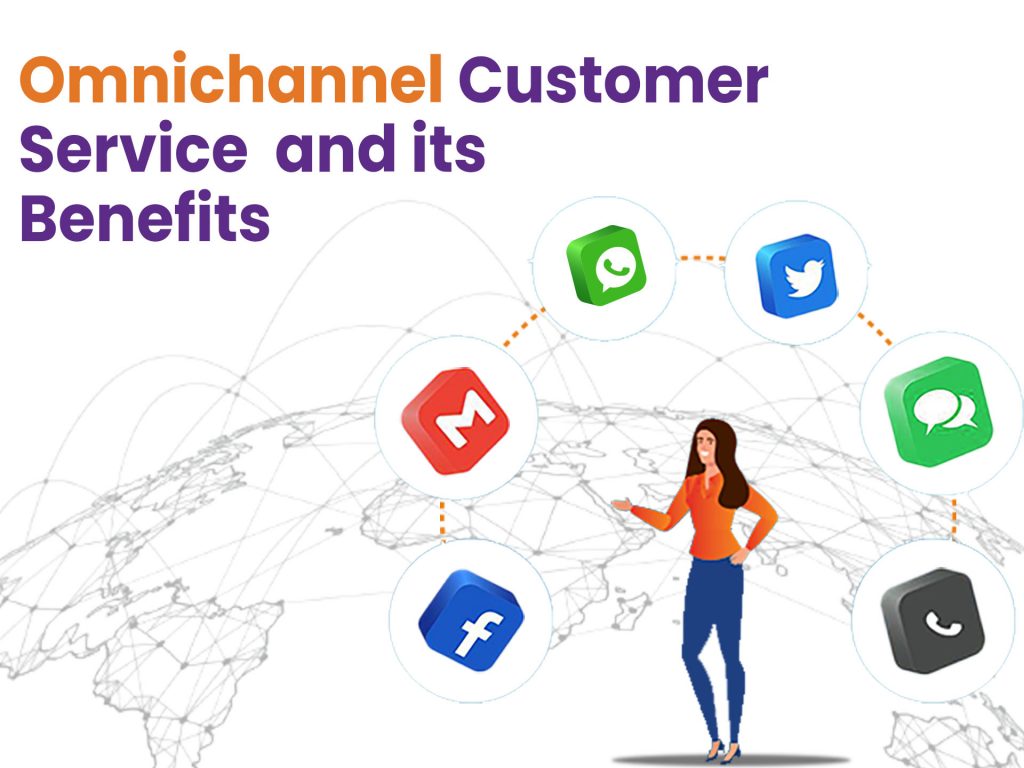
This is non-negotiable for Nigerian SMEs. Your customers are on WhatsApp. Your service desk must handle WhatsApp natively not through a fragile third-party integration, but as a core channel. All messages, regardless of channel, should flow into one unified inbox with full history visible to every agent.
CRM Integration (Built-In, Not Bolted On)
A service desk with no CRM connection is useful. A service desk with a built-in customer relationship management tool is transformative. When support agents can see a customer’s purchase history and account value without leaving the ticket, every interaction becomes smarter. When sales agents can see open support issues before calling a client, every sales conversation improves.
Basic Reporting and Analytics
Fpr the right service desk software for SMEs, you don’t need a 50-metric dashboard. You need answers to four questions: What’s our average response time? What’s our resolution rate? What are the most common complaint types? How is each team member performing? A good service desk answers these clearly. Act on what you find.
Features SMEs Can Ignore (At First)
Enterprise service desks are packed with features that sound impressive in sales demos but add zero value for lean SME teams. Don’t let them drive your decision.
AI-powered sentiment analysis. Useful at scale for large CX teams. For a 10-person team handling 100 tickets a week, it’s a distraction.
Complex multi-tier SLA management. Large enterprises need layered service level agreement hierarchies. SMEs need fast, clear resolution.
Heavy workflow customisation tools. If building your support process requires a dedicated consultant, the tool was not designed for your stage.
The rule: buy for your current reality and what you’ll realistically need in 12 months not for a hypothetical future five years away.
Budget Considerations for Nigerian SMEs
Pricing is always the loudest part of the conversation and it should be taken seriously.
Free tools provide a useful starting point. But free tiers typically cap agents, limit integration options, and restrict reporting. They’re fine for testing the concept not fine for running your business long-term.
Paid tiers for quality platforms typically charge per agent per month. At 5–15 agents, this is very manageable. Watch carefully for: per-feature pricing, annual billing that front-loads cash, and “premium” integration costs that aren’t visible in the headline price.
Think ROI, not expense. A service desk that reduces response time by 70%, prevents three customer churns this quarter, and surfaces two upsell opportunities per month pays for itself. The right framing isn’t “can we afford this?” It’s “what is the cost of not having this?”
Talk to a NotchCRM consultant about pricing that actually fits your SME budget transparent, no hidden fees.
Scalability: The Question Most SMEs Skip
The tool that works for five agents today needs to work for twenty-five agents in eighteen months. That’s not hypothetical that’s the growth trajectory of a Nigerian SME doing things right.
Before signing up for any platform, ask directly:
- Can this handle 10x my current ticket volume?
- Does pricing remain manageable as I add team members?
- Can I add new channels (WhatsApp, social, chat) without switching platforms?
- What does migration look like if I outgrow it?
The businesses that skip these questions are the ones paying for a painful platform migration during their most critical growth period.
Best Type of Service Desk Software for SMEs (Nigerians)
The clearest answer: an all-in-one platform where service desk, CRM, sales pipeline, and team management live in the same system.
Fragmented tools create fragmented customer experiences. When support is in one platform, sales is in another, and customer history lives in a spreadsheet, no one has the full picture. The customer pays for that gap every single time.
NotchCRM is built precisely for this: providing the best service desk software for SMEs for Nigerians, and growing enterprises that need unified customer management without enterprise complexity or pricing.
Explore what’s available:
- NotchCRM for Teams cross-functional collaboration and visibility
- NotchCRM Sales Module pipeline management alongside support
- NotchCRM Client Management end-to-end client visibility in one view
Common Mistakes SMEs Make When Choosing a Service Desk
Choosing the cheapest option. Free or near-free tools have their place. But choosing purely on price means choosing limitations. The cheapest tool often costs the most in lost customers, missed follow-ups, and team frustration as regards to service desk software for SMEs
Ignoring integration requirements. A service desk software for SMEs that doesn’t connect to your CRM, WhatsApp, and email creates more manual work than it removes. Integration isn’t optional.
Skipping team training. Even the best platform fails without proper onboarding. Designate an internal champion. Budget time for training. Make adoption a goal, not an assumption.
Buying for today only. The tool you choose now constrains or enables your next growth phase. Scalability deserves as much weight as current pricing especially when sourcing for the right service desk software for SMEs
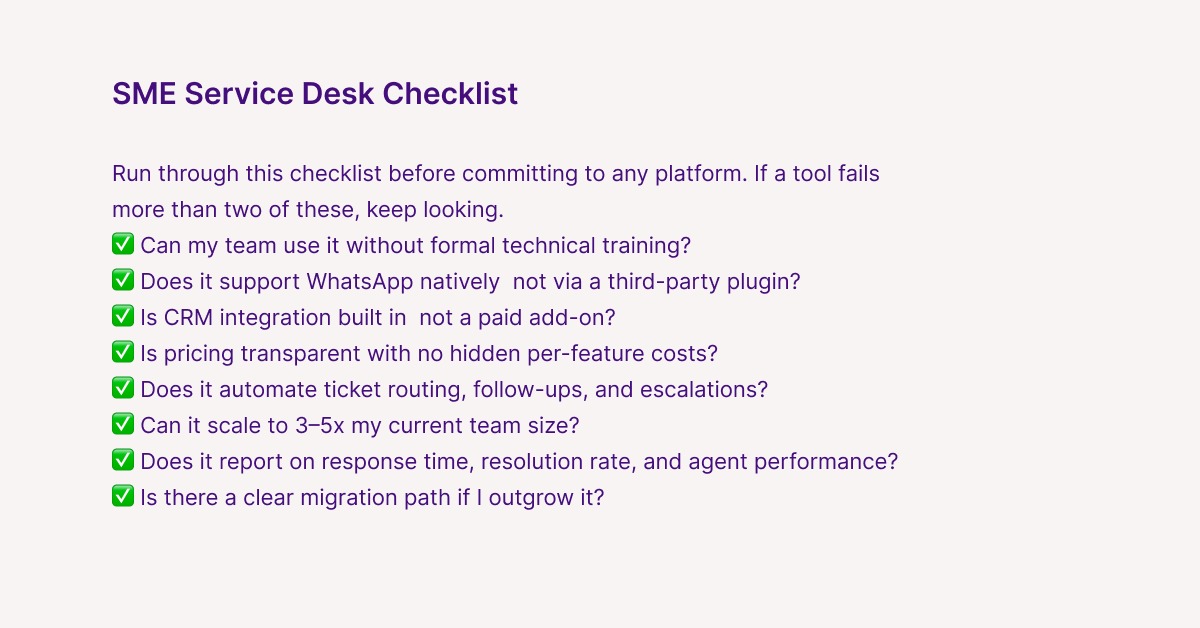
Checklist: Service Desk For SMEs
Conclusion
The right service desk software for SMEs isn’t just a support tool. For a Nigerian business in 2026, it’s infrastructure the system that converts your customer communication from chaos into competitive advantage.
The wrong tool costs you customers. The right one retains them, grows them, and turns your support function into a revenue contributor.
Don’t let budget pressure push you into a tool that limits you within a year. Don’t let feature overload drag you into a platform your team will never fully adopt. Find the fit: simple, powerful, integrated, and built for growth.
Explore an exclusive walkthrough with NotchCRM and see what Nigerian SMEs are building without enterprise budgets or enterprise complexity.
For the full strategic context, read: Service Desk in Nigeria (2026): The Complete Guide. And for a side-by-side tool comparison before you decide: 7 Best Service Desk Softwares for Customer Support.
Frequently Asked Questions
What service desk software is best for a Nigerian SME with a small budget? NotchCRM offers SME-friendly pricing with full service desk and CRM functionality. It’s designed for Nigerian business realities WhatsApp-native, easy to adopt, and scalable. Speak with the team for pricing aligned to your team size.
Is WhatsApp integration really necessary in a service desk for Nigerian businesses? Yes, unambiguously. Over 90% of Nigerian SMEs use WhatsApp as a primary customer communication channel. A service desk without native WhatsApp support creates a gap that defeats the entire purpose of centralising communication.
How long does it take to implement a service desk in a Nigerian SME? With the right platform, most Nigerian SMEs are operational within a few days. Tools like NotchCRM are designed for fast onboarding without requiring an IT team or technical implementation support.