It was a Tuesday afternoon in Lagos when Tunde’s phone buzzed for the forty-third time that day.
Not sales leads. Not investor updates. Complaints.
A customer in Abuja hadn’t received her order. Another in Port Harcourt was asking about a refund from two weeks ago, a conversation buried somewhere in a WhatsApp thread of 847 messages. His sales rep had promised a client a discount that the operations team knew nothing about. And his support person, who is the one person that held all the customer context in her head, had just resigned.
Tunde didn’t have a bad business. He had a fast-growing business with no system to hold it together.
This story isn’t unique. Across Nigeria, thousands of founders, operations leads, and sales teams are running customer relationships on instinct, personal phones, and WhatsApp groups that were never designed for business management. The result? Revenue leaks quietly. Customers churn without warning. Teams burn out.
The fix isn’t more staff. It’s a service desk and in 2026, the right service desk is the difference between a business that scales and one that implodes under its own growth.
This complete guide covers everything you need to know: what a service desk is, why it matters in Nigeria’s unique business environment, what features to look for, how to choose the right one, and why the smartest Nigerian businesses are already using CRM-powered service desks to win.
What Is a Service Desk?
Forget the technical jargon for a moment. Here’s the simplest way to think about it.
A service desk is your business’s central command centre for every customer interaction. Every message, complaint, inquiry, and request, regardless of which channel it came through, flows into one organised, trackable system. Tickets get assigned. Deadlines get set. Resolutions get logged. Nothing falls through the cracks.
But it hasn’t always looked this way.
According to Gartner’s IT Glossary, a service desk is a help desk equipped with the resources for resolving service requests and problem calls, giving teams the ability to diagnose, troubleshoot, and resolve issues rather than simply passing them along. That foundational definition has since expanded far beyond IT into customer support, sales alignment, and full relationship management for businesses of every size.
The Evolution: Help Desk → Service Desk → CRM-Powered Service Desk
In the early days of customer support software, businesses used help desks and simple ticketing tools that logged problems and tracked resolutions. A customer had an issue, a ticket was opened, an agent resolved it, and the ticket was closed. Linear. Reactive. Isolated.
Then the service desk emerged. Broader in scope, it moved beyond just fixing problems. It began managing ongoing customer relationships, tracking interaction history, and connecting support to wider business operations.
Today, the most powerful evolution is the CRM-powered service desk, where your customer relationship management tool and your support operations share the same platform. Every complaint, every purchase, every conversation lives inside a single customer profile. Your sales team, support team, and operations team all see the same truth.
For Nigerian businesses managing dozens of customer touchpoints daily, this isn’t a luxury upgrade. It’s foundational infrastructure.
Explore NotchCRM’s Service Desk, built to unify support and sales for Nigerian businesses.
Here’s what most international SaaS blogs miss entirely: Nigerian businesses don’t operate the way their content assumes.
Your customers aren’t raising formal support tickets through a web portal. They’re sending voice notes on WhatsApp at 10 PM. They’re calling the sales rep directly when there’s a complaint because that’s the number they have. They’re DMing your brand on Instagram, then following up via email, then calling again because they didn’t hear back.
Meanwhile, your team is navigating:
Multi-channel chaos. WhatsApp, calls, email, Instagram, Twitter all running simultaneously, all managed manually, all creating the same problem: no central record of what was said, promised, or resolved.
Infrastructure realities. Power interruptions and inconsistent internet connectivity mean cloud tools must be reliable, mobile-first, and forgiving of connectivity drops. A service desk that requires a stable broadband connection to function isn’t built for Nigerian operational realities.
Lean teams under founder pressure. Most Nigerian SMEs don’t have a dedicated customer experience department. The same person handling support is often also handling admin, sometimes also handling sales.
The expectation gap. Nigerian customers have been trained by Jumia, Flutterwave, Paystack, and global brands to expect fast, professional, personalised responses. They extend no grace period for “we’re a small team.” The standard is the standard.
A service desk built for this context must be mobile-first, WhatsApp-native, simple enough for non-technical teams, and affordable enough for SME budgets. Most global tools miss at least two of these. That’s why the conversation about service desks in Nigeria must be contextual, not a copy-paste from a Silicon Valley playbook.
Service Desk vs Help Desk: A Quick Overview
Many Nigerian businesses use the terms interchangeably. They shouldn’t.
| Feature | Help Desk | Service Desk |
| Primary focus | Resolving tickets | Managing customer relationships |
| Approach | Reactive | Proactive + strategic |
| Scope | Narrow support only | Broad support + CRM + sales alignment |
| Customer view | Per-ticket, isolated | Full relationship history |
| Integration | Standalone | CRM-integrated |
| Team visibility | Support team only | Cross-functional |
| Revenue impact | Indirect | Direct upsell, retention, conversion |
| Best for | Very small, simple teams | Growing businesses |
The core difference is philosophy. A help desk closes tickets. A service desk builds relationships.
For a deeper breakdown, including which tool fits your exact business stage, read our full guide on Service Desk vs Help Desk: Which Is Better for Your Team?.
Key Features of a Modern Service Desk
Not every service desk is worth its price tag. These are the features that separate genuinely useful platforms from expensive disappointments.
Ticket Management System
Every customer interaction, including WhatsApp messages, phone calls, email, and social DM, converts automatically into a structured ticket. Each ticket has an owner, a deadline, a status, and a full history. Your team always knows what’s been handled and what’s waiting. Nothing disappears into a personal inbox.
Omnichannel Support
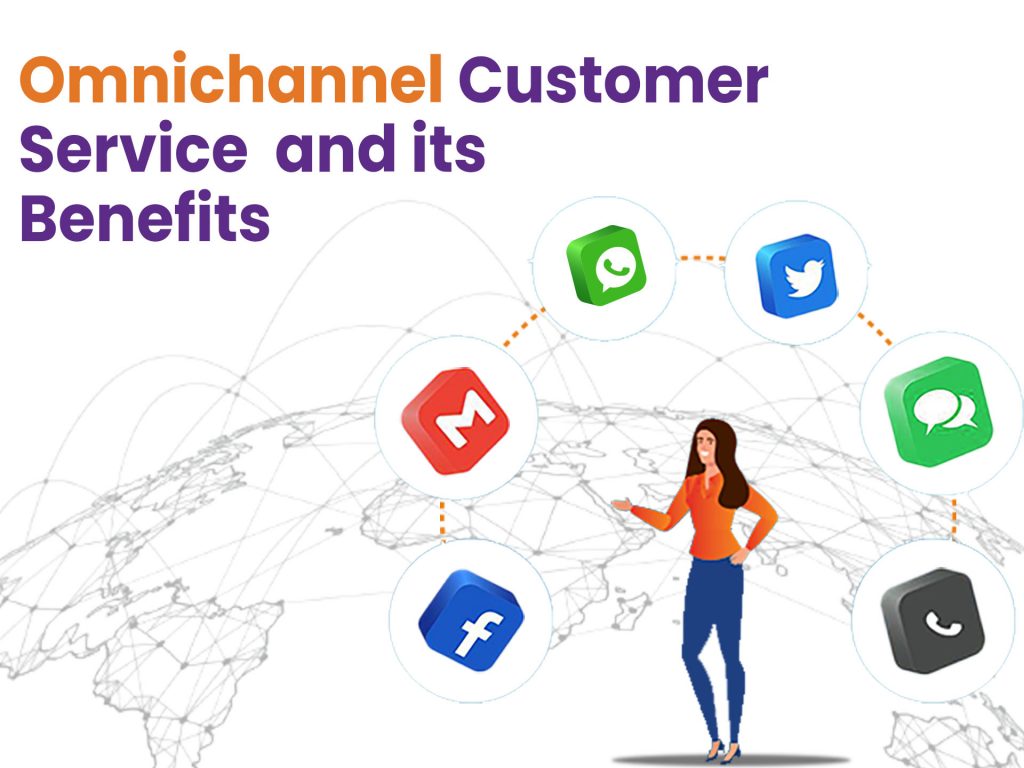
Nigerian customers use an average of three to four channels to communicate with businesses. The right service desk pulls all of these into a single inbox. Your agent sees the full conversation history regardless of which channel the customer used. No more “we need to check the WhatsApp” followed by “we need to check the email” followed by silence.
Automation and Workflows
Manual follow-ups are productivity killers. Smart service desks automate: instant acknowledgement messages, ticket routing to the right team member, escalation triggers when issues sit unresolved, and scheduled follow-up reminders. One automation rule can replace hours of manual daily admin.
Knowledge Base
A self-service knowledge base lets customers answer common questions without contacting your team. For Nigerian SMEs with lean support staff, this reduces ticket volume significantly, freeing agents for complex issues that actually need human attention.
Reporting and Analytics
“How long does it take us to respond?” “Which team member resolves tickets fastest?” “What complaint comes up most often?” A quality service desk answers these questions with real data, not estimates. Data drives better hiring decisions, product improvements, and operations changes.
CRM Integration
This feature transforms a service desk from a support tool into a revenue engine. When your service desk and customer relationship management tool operate on the same platform, every support interaction links to a customer’s complete profile, their purchase history, deal stage, complaint history, and lifetime value. Support becomes context-rich. Sales becomes better informed. The whole business works from the same truth.
See how NotchCRM unifies customer data, service desk, and sales pipeline for Nigerian teams in one place.
Types of Service Desk Software
Understanding the categories prevents expensive mismatches.
IT Service Desk: Designed for internal IT teams managing employee technical issues. Useful for large enterprises with dedicated IT departments. Not designed for customer-facing support operations.
Customer Service Desk: Built specifically for external customer support, handling complaints, inquiries, orders, and feedback. This is what the majority of Nigerian businesses need.
Enterprise Service Desk: Large-scale platforms built for complex organisations with multiple departments, high ticket volumes, and dedicated CX teams. Often too complex and expensive for Nigerian SMEs.
CRM-Integrated Service Desk: The most strategic option available in 2026. This category, where NotchCRM sits, combines customer relationship management, sales tracking, and support operations inside one unified system. It’s built for businesses that understand support and sales are two sides of the same coin.
Benefits of a Service Desk for Nigerian Businesses
Let’s move past theory and into what actually changes when a Nigerian business implements a proper service desk.
Faster Response Times
Speed is the most visible benefit and it matters enormously. According to Salesforce’s 2024 State of Service report, 88% of customers say good service makes them more likely to purchase from the same company again. The same research found that 85% of service decision makers now expect their teams to actively contribute to revenue, not just resolve complaints. With automated routing and unified inboxes, response times drop from hours to minutes without adding headcount. In a market where your competitor is one WhatsApp message away, speed is a genuine competitive advantage.
Better Customer Experience
Consistency builds loyalty. When every interaction is tracked, every agent has full context, and every customer gets a personal, informed response, the experience feels premium regardless of your company size. Nigerian customers who feel valued don’t look for alternatives.
Centralized Communication
No more “I thought you replied to that.” No more “which WhatsApp group was this in?” No more new team members starting blind because all the customer history was in a colleague’s personal phone. Everything lives in one place, accessible by everyone who needs it.
Increased Sales Conversion
A support interaction is a sales opportunity in disguise. When your service desk integrates with your CRM, your agents can see a customer’s purchase history and flag upsell opportunities during complaint resolution. A well-handled complaint from a loyal customer often leads to a larger reorder.
Team Accountability
Clear ticket ownership means clear accountability. Managers can see who’s responding, who’s overloaded, and where the system is failing without micromanaging. Performance becomes measurable.
Data-Driven Decisions
Monthly reports on complaint trends, resolution rates, and customer satisfaction scores help founders make smarter decisions. Is the recurring complaint about delivery times a logistics problem or a communication problem? Data tells you. Gut feeling guesses.
Your team is ready to work smarter. Book a demo with NotchCRM and see what structured customer management actually looks like.
Where Nigerian Businesses Lose Customer Data
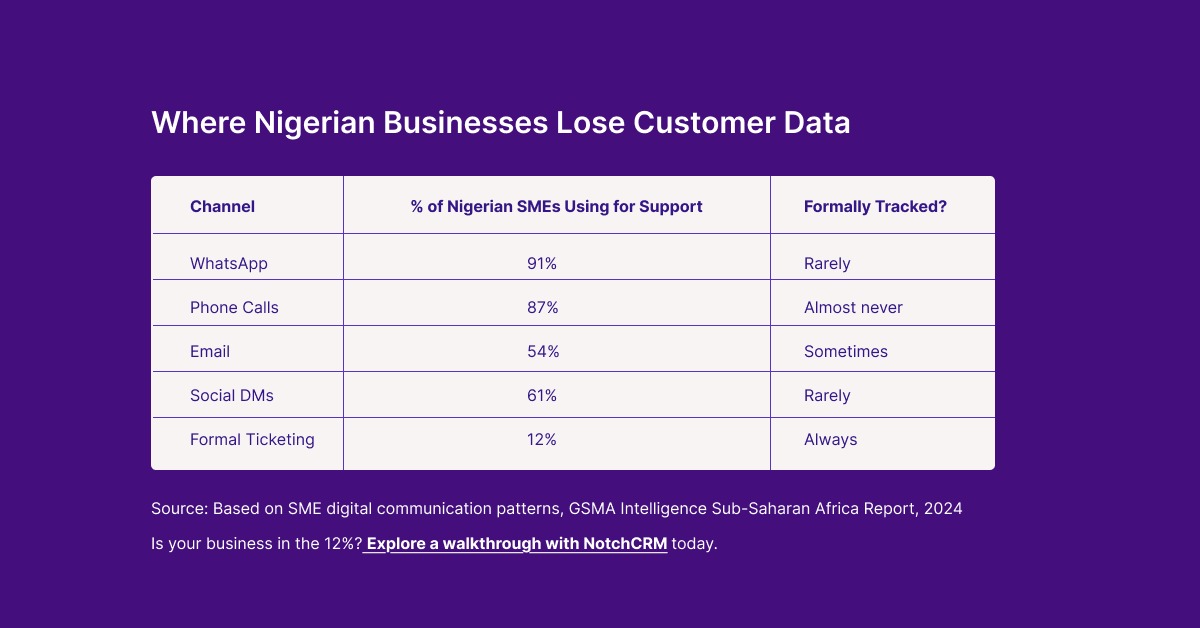
Source: Based on SME digital communication patterns, GSMA Intelligence Sub-Saharan Africa Report, 2024
How a Service Desk Supports Sales, Not Just Support
Most Nigerian businesses treat support as a cost centre. The ones growing fastest treat it as a revenue function.
Here’s the shift: every customer interaction is a data point. And every data point, when captured in a CRM-integrated service desk, becomes an opportunity.
Turning Complaints into Opportunities
A customer who complains and receives a fast, empathetic, complete resolution becomes your most vocal advocate. A customer who complains and gets ignored becomes your most vocal critic. With structured ticket management, the first scenario happens consistently. Without it, the second scenario happens randomly and you never know which until it’s too late.
Tracking the Full Customer Journey
From the first inquiry to the first purchase to the fifth reorder to the first complaint, a CRM-integrated service desk gives you a complete timeline for every customer relationship. You’re not responding in the dark. You’re responding with full context which is the difference between a generic resolution and a personalized experience.
Aligning Support and Sales Teams
One of the most expensive silos in Nigerian SMEs is the gap between sales and support. Sales makes promises. Support has to deliver. When those two teams can’t see each other’s information, customers receive contradictory experiences. When they work from the same platform, the experience becomes coherent and trust builds.
See how NotchCRM’s Sales module connects your deal pipeline directly to your support history closing the gap between what you promise and what you deliver.
How to Choose the Right Service Desk Software
Choosing the wrong tool is expensive in ways that go beyond the subscription fee. Wasted onboarding time. Low team adoption. A migration project six months later. Here’s what actually matters:
Business size and current complexity. A 10-person team doesn’t need a 200-feature enterprise platform. Start with what fits your scale and can grow with you. Buying too large creates adoption failure.
Integration depth. Does the tool connect with your email, WhatsApp, and CRM? Disconnected tools create disconnected customer experiences which defeats the entire purpose.
Ease of use. If your team needs three days of training to log a ticket, adoption will collapse within two weeks. Prioritize intuitive interfaces over impressive feature lists.
Pricing transparency. Some tools appear affordable until you add per-user fees, integration costs, and feature tier upgrades. Evaluate total cost not just the headline price.
Scalability. The tool that works for you today must still work when your team doubles and your ticket volume triples. Build for where you’re going.
Common Mistakes Businesses Make
These errors are costing Nigerian businesses customers and revenue right now.
Using WhatsApp as a CRM. WhatsApp is a communication channel. It was never designed to track customer histories, assign ownership, analyze trends, or generate reports. Important conversations get buried. Follow-ups get missed. When the person managing the WhatsApp leaves, the customer history leaves with them.
Choosing overly complex tools. Enterprise platforms built for 500-person CX teams create adoption disasters in 15-person SMEs. Complexity breeds avoidance. Your team will return to WhatsApp within two weeks of a painful onboarding.
Ignoring CRM integration. A service desk with no CRM connection is better than nothing but not by much. The real value emerges when support data and customer profiles merge into one system.
Poor onboarding. Even the best service desk fails without team training and an internal champion driving adoption. Budget time and energy for this not just the subscription cost.
Service Desk ROI for Nigerian Businesses.
| Metric | Without Service Desk | With Service Desk |
| Avg. Response Time | 6–24 hours | Under 1 hour |
| Customer Retention Rate | ~60% | 80%+ |
| Team Hours Lost to Manual Tracking | 10–15 hrs/week | Under 2 hrs/week |
| Upsell Opportunities Captured | Rarely | Consistently |
| Revenue Leakage from Missed Follow-Ups | High | Near zero |
Benchmarks based on Gartner Customer Service Research and Salesforce State of Service Report, 2024
Best Service Desk Software in Nigeria
The global options Zendesk, Freshdesk, HubSpot Service Hub offer impressive feature sets. But they were built for markets with large IT teams, stable internet infrastructure, and software budgets that most Nigerian SMEs don’t have.
For the Nigerian context, the most practical choice is a platform that combines service desk functionality with a CRM, handles WhatsApp natively, is priced for local market realities, and doesn’t require a dedicated implementation team to set up.
NotchCRM was built with exactly this context in mind. It’s the platform Nigerian businesses use when they’re ready to stop managing customers through gut feeling and start managing them through systems, which makes it the best service desk software for Nigerian businesses.
For the complete breakdown of the top tools with honest comparisons of features, pricing, and fit read our guide on the 7 Best Service Desk Softwares for Customer Support.
Why NotchCRM Is Built for Nigerian Businesses
Most CRM and service desk platforms were designed in San Francisco for San Francisco problems. NotchCRM was built with Nigerian business realities at the centre.
Unified customer data. Every customer’s full history of sales conversations, support tickets, complaints, orders, and deal stages lives in one profile. Every team member works from the same truth.
Sales and support in one place. Your support inbox and your sales pipeline are connected. A deal that stalls because of an unresolved complaint gets flagged. A retained customer becomes a visible upsell opportunity.
Built for SMEs, scalable to enterprise. NotchCRM doesn’t ask you to buy features you don’t need yet. Start with what you need. Scale as the business grows without migrating platforms.
Removes the silos. When your sales team, support team, and operations team share one platform, customers get one coherent experience. Not three contradictory ones.
Explore the full platform:
- NotchCRM for Teams cross-functional collaboration
- NotchCRM Target goal tracking and performance management
- NotchCRM Client Management end-to-end client visibility
Service Desk Decision Guide
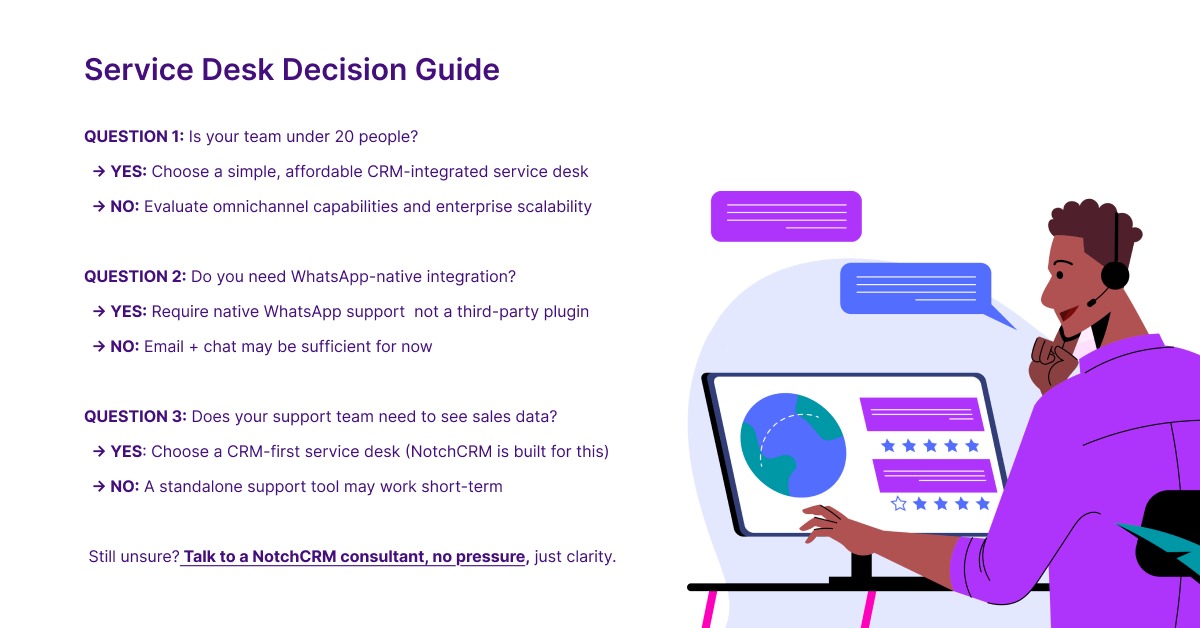
I
Still unsure?Talk to a NotchCRM consultant, no pressure, just clarity.
Here’s the truth that Tunde and every Nigerian founder like him eventually discovers: you cannot scale a business on WhatsApp groups and memory.
Growth is a problem that only systems can solve. Not harder work. Not more staff. Systems.
A service desk is the system that holds your customer relationships together as your business grows. It’s the infrastructure that turns reactive chaos into proactive management. And when it’s powered by the right customer relationship management tool, it becomes one of the highest-ROI investments your business can make, converting support from a cost centre into a revenue engine.
The businesses winning in Nigeria’s 2026 market won’t just have the best products. They’ll have the best systems behind those products.
Conclusion
You’ve read this far because something in your current customer support process isn’t working. Maybe it’s the missed follow-ups. Maybe it’s the team confusion. Maybe it’s the founder still acting as the default complaint handler at 11 PM.
There is a better way.
If your team is juggling conversations across platforms, it’s time to upgrade to a service desk that actually connects everything your support tickets, your sales pipeline, your customer history, and your team’s daily workflow.
Book a free demo with NotchCRM today and see why Nigerian businesses are choosing it as the foundation for scalable, revenue-driving customer management.
Frequently Asked Questions
What is a service desk and how is it different from a help desk? A help desk resolves individual support tickets in isolation. A service desk manages the full customer relationship tracking history, integrating with your CRM, connecting support to sales, and providing data for business decisions. For growing Nigerian businesses, a service desk is the right long-term choice. Explore the full comparison in our Service Desk vs Help Desk guide.
Can a small Nigerian business afford a service desk? Yes. Platforms like NotchCRM are specifically designed for Nigerian SMEs offering service desk and CRM functionality at pricing that fits local budgets. The real question is whether you can afford not to have one, given the revenue leaking from untracked follow-ups and customer churn.
Does a service desk work with WhatsApp? The best modern service desks including NotchCRM integrate natively with WhatsApp, pulling all messages into a unified inbox alongside email and other channels. This is critical for Nigerian businesses where WhatsApp is the dominant customer communication channel.
How quickly will I see results after implementing a service desk? Most businesses see measurable improvements in response time and ticket resolution within the first 30 days. Revenue impact from improved retention typically becomes visible within 60–90 days.
What makes NotchCRM different from global service desk tools? NotchCRM was built with the Nigerian business context in mind mobile-first, WhatsApp-native, affordable for SMEs, and combining CRM, sales pipeline, and service desk in one platform. Global tools like Zendesk and Freshdesk were built for different markets and often require enterprise budgets and IT teams to manage effectively.
How do I get started? The easiest first step is a walkthrough with the NotchCRM team. Book your free session here no commitment required, just clarity on what the right system looks like for your business.